Your AI Stack Is Probably Too Complicated
What to keep. What to cut. What actually works.
There is a stage of adopting AI where productivity starts going backward. One assistant becomes two. Then research, meetings, writing, images, coding, browsers, agents, and a tool for turning one model’s output into a task for another. Soon you have built a sophisticated system for deciding which textbox to type into.
Congratulations. You have an AI assistant stack. Now we need to fix it.
The problem is not that multiple tools are inherently bad. Specialists can be excellent. The problem is accumulation without architecture: subscriptions get added because a demo was impressive, nothing gets removed, and nobody owns the decision.
Start with jobs, not logos
List every AI product you pay for and the job it actually performed during the last thirty days. Not its marketing category. Not what it could do. What did it do? Summarize client calls? Draft proposals? Search internal documents? Write code? Classify inbound messages?
You may discover four products doing essentially the same job. That is not a stack. That is a software audition nobody remembered to end.
For each product, record its recurring job, frequency, owner, monthly cost, unique advantage, and likely replacement. The useful part is forcing every subscription to explain itself.
The five tests
- Is it meaningfully better at a recurring job? An occasional preference is not a repeatable advantage.
- Does it have context the others do not? Connected email, files, code, CRM, and documentation can matter more than an abstract model ranking. They also create permission and privacy questions.
- Does it remove a step? Exporting, uploading, explaining, correcting, and pasting may cost more than the feature saves.
- Does somebody own it? Approved use, integrations, validation, renewals, and offboarding need an owner.
- Would you notice if it disappeared? If no meaningful work would stop or slow down, scrutinize the renewal.
Give tools roles
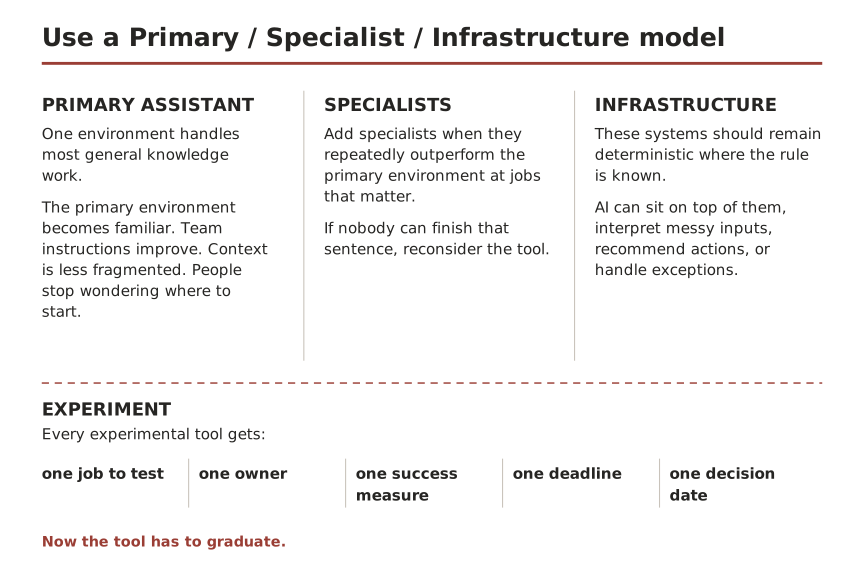
A useful default for a small team is one primary assistant for general knowledge work; specialists for repeated advantages in research, coding, media, or domain analysis; and deterministic infrastructure for records, permissions, approvals, and known workflows.
Add a fourth category: experiments. Every experimental tool gets one job to test, one owner, one success measure, one deadline, and a keep, consolidate, or cut decision. A credit card is not a graduation ceremony.
Do not force one product to do everything poorly. Designed redundancy can be valuable for independent cross-checks or outages. Write down why the overlap exists. If you cannot explain it cleanly, the stack may be carrying dead weight.
Measure the context-transfer tax
Subscription dollars are easy to count. Human translation is harder and often more expensive. Track the number of tools touched, manual copy-and-paste steps, minutes spent re-explaining context, and failure points introduced by moving between systems.
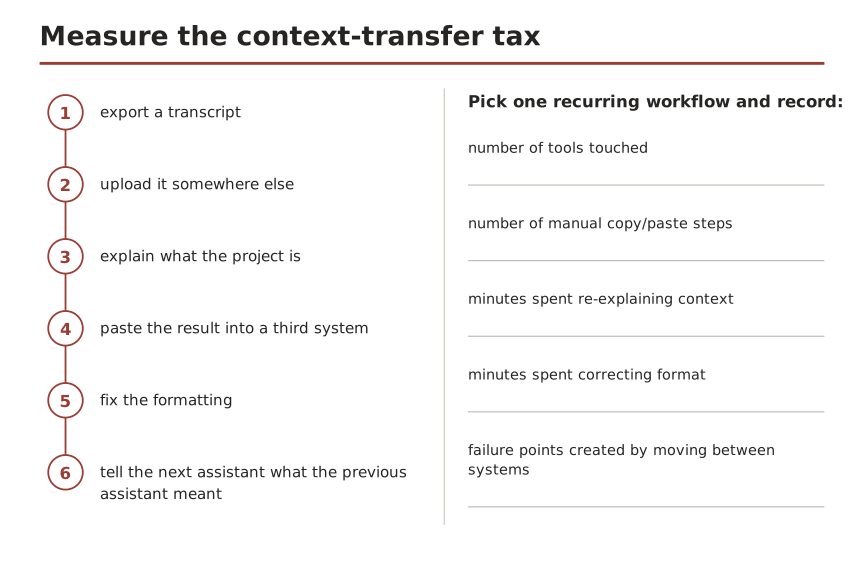
A paid specialist that removes forty minutes of transfer work every week may be cheap. A free tool that adds ten handoffs can be expensive.
The twenty-minute audit
Create one row per tool. Record owner, monthly cost, primary job, frequency, unique capability, workflow impact, data sensitivity, replacement, and decision. Use four outcomes: keep, consolidate, test, or cut.
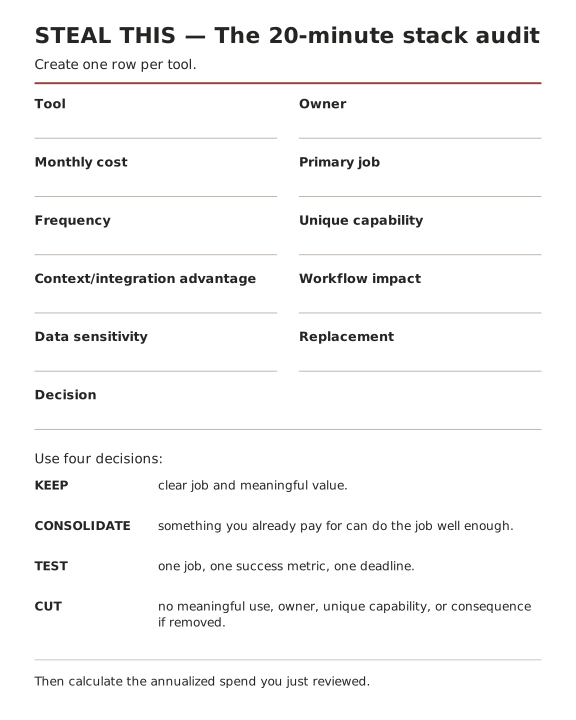
Repeat before renewals. Ask what recurring job the tool performed, what friction it removed, what now overlaps with products you already own, and what would break if you canceled tomorrow. The question is not whether the tool is good. Most of them are. The question is whether it is still earning a place in your operating system.
Your AI assistant should be replaceable. Your business should not be. The goal was never to put AI everywhere. The goal was to make the work better.
Sloane is synthetic. Her byline represents the established editorial voice of AI Tips for Business.